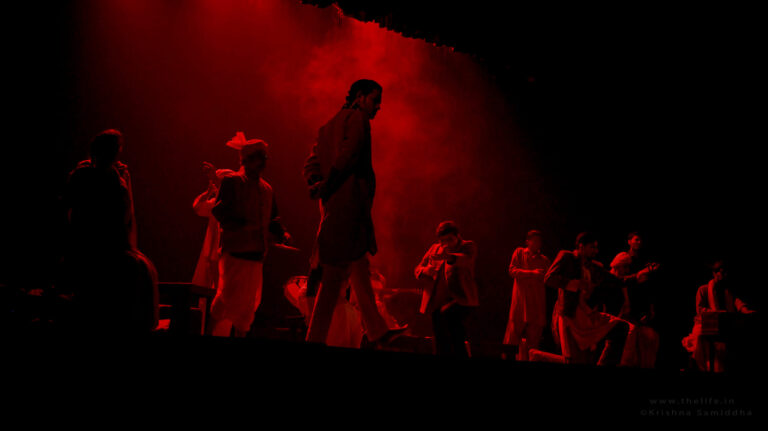

𝐍𝐨𝐭𝐢𝐨𝐧(𝐬): 𝐀𝐧 𝐎𝐝𝐞 𝐭𝐨 𝐑𝐚𝐰 𝐓𝐡𝐞𝐚𝐭𝐫𝐢𝐜𝐚𝐥 𝐄𝐱𝐩𝐞𝐫𝐢𝐞𝐧𝐜𝐞 𝐛𝐲 𝐒𝐚𝐯𝐢𝐭𝐚 𝐑𝐚𝐧𝐢
Notion(s) : in between you and me by Savita Rani …this play begins with the sensation of touching Imaginary water illuminated by a beam of circular light – an ethereal experience that sets the stage for the profound journey ahead. Like ripples in a vast ocean, it all starts with a simple Imaginary touch.
In the first 3 minutes, there is no dialogue, and then dialogue emerges – to live or not – a dilemma expressed through the language of Shakespeare, but as ancient as humanity itself and with emergence of dialogue play morphs into a narrative, eventually echoing the similar raw energy of Allen Ginsberg’s “Howl” alongside the frenetic soundscape of the animal kingdom .
In a departure from traditional dialogue-driven narratives, the first three minutes are devoid of spoken words. Instead, the language of movement takes center stage, illustrating the innate capacity of expression beyond mere words Then Savita Rani’s “Notion(s)” unfolds with the grace of a gentle stream, each moment flowing seamlessly into the next. With every movement, she paints a vivid portrait of the human experience, inviting the audience to immerse themselves in the depths of emotion and introspection.
The structure of the play was challenging and posed a significant challenge for theater viewers. The first part was clear, as it delved into the story of a woman—an unspoken narrative that resonates in every home. However, the second & third part were more perplexing, akin to Allen Ginsberg’s “Howl,” where the meanings of words plunge into a pit of emotion and charged intensity. This shift in tone and narrative style demanded active engagement from the audience, compelling them to navigate through layers of symbolism and emotion to grasp the essence of the performance.
“I faced a dilemma whether to like or dislike this play because it presented raw emotion. However, I pondered how one can discuss raw emotion that requires exploration. Eventually, I realized that one must free their mind within the raw arena of performance.”
“In grappling with my dilemma regarding whether to like or dislike this play due to its presentation of raw emotion, I find myself drawn to the insights of theater theorist Antonin Artaud. In his seminal work ‘The Theatre and Its Double,’ Artaud emphasizes the importance of unleashing raw emotions on stage, advocating for a theater of cruelty that shocks audiences into confronting the depths of human experience. Reflecting on Artaud’s ideas, I am torn between appreciating the play’s intense emotional impact and questioning how one can critique such raw authenticity.
As I delve deeper into the intersection of emotion and performance, I am reminded of Richard Schechner’s concept of ‘restored behavior’ in his book ‘Performance Theory.’ Schechner suggests that performers must free themselves from societal constraints and tap into primal instincts to embody authentic emotion on stage. Applying Schechner’s theory to my dilemma, I realize that engaging with raw emotion necessitates a willingness to explore the depths of human experience without preconceived judgments.
This dilemma leads me to a realization: to truly appreciate the raw emotion presented in the play, one must cultivate a state of openness and vulnerability, allowing the performance to provoke visceral reactions and challenge conventional notions of artistry. As Artaud famously said, ‘Theater is a means of awakening dormant sentiments and bringing them into the light of day.'”
And light to the eye…( …There was direct light shining into the audience’s eyes, making it uncomfortable to watch the play…) Is it simple that when you perceive something through an inner light, you are unable to see reality clearly? And as the light cascades into the eye, illuminating the world around us, one wonders: is it merely a trick of perception? Is our inner light, our preconceptions and biases, casting shadows upon the truth, obscuring the reality that lies before us? As we navigate the complexities of perception, we grapple with the notion that our subjective interpretations may cloud our ability to see the world as it truly is.
This play was a challenge for us as men, as theater viewers, and as individuals. It compelled us to confront deep-seated notions and societal constructs, urging introspection and reflection on our roles within the broader narrative of humanity. As we grappled with the themes and messages woven into the fabric of the performance, we were forced to confront our own biases, prejudices, and preconceptions.
The play, with its intricate layers and multifaceted narrative, epitomized the concept of “active spectatorship” proposed by theater theorist Hans-Thies Lehmann in his seminal work “Postdramatic Theatre.” As Lehmann suggests, contemporary theater challenges viewers to engage actively with the performance, transcending the traditional role of passive observers. In “Notion(s),” this demand for active spectatorship was palpable, as the audience was tasked with deciphering the symbolism and unraveling the complexities of the narrative.
This requirement for heightened viewer engagement resonates with the words of theater scholar Bert O. States, who emphasizes the importance of “deep play” in theatrical experiences. In his book “Great Reckonings in Little Rooms,” States explores the immersive nature of theater, arguing that it demands active participation from the audience to fully comprehend its artistic intentions.
As the audience navigated through the play’s intricate structure, they were confronted with a barrage of sensory stimuli—a cacophony of sound, a tapestry of movement, and a whirlwind of emotions. This sensory overload mirrored the concepts of “hypermediacy” and “immersion” discussed by media theorist Jay David Bolter and Richard Grusin in “Remediation: Understanding New Media.” In their exploration of contemporary media forms, Bolter and Grusin posit that hypermediacy disrupts traditional modes of perception, blurring the boundaries between reality and representation. In “Notion(s),” this blurring of boundaries was evident, as the audience was plunged into a sensory-rich environment that challenged their perceptions of reality.
In the words of theater critic Antonin Artaud, “Theater of Cruelty” seeks to awaken dormant emotions and provoke visceral reactions in its audience. In “Notion(s),” this ethos of cruelty was not manifested in physical violence but in the emotional intensity of the performance. As the audience grappled with the play’s challenging themes and complex narrative, they were forced to confront uncomfortable truths and interrogate their own beliefs and biases.
, “Notion(s)” transcended the traditional boundaries of theater, demanding active engagement from its audience and challenging them to navigate through layers of symbolism and emotion. Drawing upon theories of active spectatorship, deep play, hypermediacy, and theater of cruelty, the play invited viewers on a transformative journey of self-discovery and introspection.
Then unfolds the story of her, intertwined with the narrative of her name. Yet, is this narrative solely hers, or does it reverberate universally among all women? The tale of one becomes the tale of many. She recounts how her teacher insisted on changing her name after marriage, urging her to abandon her father’s surname, “Kadyan,” and adopt a temporary name. Savita was given choices,Kumari, Rani Devi,and she chose “Rani.” This decision echoes the story of my mother, once my mother Usha Rani, my mother unpublished poet and collector of folk songs, before marriage, had same choice and now she lost in the annals of time. It is similar experience like autobiography of Kamal Das, a reminder that a woman’s autobiography is akin to scaling a mountain. And so, the play unfolds like a journey of ascent, each step a testament to the collective struggles of womanhood.
The unfolding narrative of Savita’s identity and the weight of her name resonate deeply with theories of gender identity and cultural hegemony, as explored by feminist scholar Judith Butler in her groundbreaking work “Gender Trouble.” Butler posits that gender is performative, shaped by societal norms and expectations. In “Notion(s),” Savita’s struggle with her name reflects the broader societal pressure on women to conform to patriarchal conventions, echoing Butler’s assertion that gender identity is constructed and enacted through repeated performances.
Moreover, the idea that Savita’s personal narrative reverberates universally among all women aligns with the concept of “intersectionality” coined by legal scholar Kimberlé Crenshaw in her influential paper “Mapping the Margins: Intersectionality, Identity Politics, and Violence against Women of Color.” Intersectionality recognizes that individuals’ experiences are shaped by intersecting social identities such as race, class, and gender. In “Notion(s),” Savita’s story serves as a microcosm of the complex intersections of identity and power dynamics faced by women across diverse backgrounds.
And breathing—someone’s presence catches in your lungs, their essence swirling within your chest. The utilization of sound was soul-crushing; it transcended mere music, becoming a conduit for the teleportation of raw emotion. Moreover, the notion of breathing and its metaphorical resonance with presence and essence draws parallels to the theories of embodied perception and kinesthetic empathy discussed by dance scholar Susan Leigh Foster in “Choreographing Empathy: Kinesthesia in Performance.” Foster suggests that the physical experience of movement and breath can foster a profound sense of connection and empathy between performers and audience members. In “Notion(s),” the evocative imagery of breathing as a vessel for presence and essence invites viewers to engage kinesthetically with the performance, heightening their emotional investment and sense of connection with the narrative. Like it was proposed by theater theorist Brian Massumi in his work “Parables for the Virtual: Movement, Affect, Sensation.” Massumi argues that affect, or the pre-conscious experience of sensation and emotion, plays a crucial role in shaping our responses to artistic stimuli.
Through its manipulation of sound and imagery, the play offers a transformative journey into the realm of raw emotion, inviting audiences to explore the depths of human experience through sensory engagement. ” “And I was delighted with this experience, facilitated by the participation of two capable theatre practitioners from Patna. Vinay Chauhan expertly handled the lighting, while Rajeev Roy was responsible for sound handling.”
Her story becomes a symbol of the silent chambers of oppression. Slowly, it evolves into a kind of hell where every woman resides. This play becomes a almost 62-minute journey through the depths of hell, challenging the audience to step outside their comfort zones and confront uncomfortable truths. It serves as an open challenge to traditional forms of theater.
“And then comes a monster atop…on the chest—her husband. It was a scene of discomfort for any male, a portrayal of the harrowing reality of marital rape. It played out to discomfit, shedding light on the dark corners of domestic abuse and the horrors endured behind closed doors.”
Furthermore, the scene’s depiction of the husband as a monstrous figure aligns with feminist critiques of patriarchal power dynamics, as discussed by feminist scholar Judith Butler in her book “Gender Trouble: Feminism and the Subversion of Identity.” Butler argues that gender is performative and constructed within power relations, with acts of violence and domination perpetuating oppressive gender norms. In “Notion(s),” the husband’s portrayal as a monstrous entity highlights the pervasive nature of patriarchal violence and the ways in which it intersects with broader systems of oppression.
Moreover, the scene’s emphasis on discomfort and discomfiture draws parallels to the concept of “unpleasure” in psychoanalytic theory, as explored by Sigmund Freud in his seminal work “Beyond the Pleasure Principle.” Freud suggests that certain experiences, particularly those associated with trauma and repression, evoke feelings of discomfort and unease. In “Notion(s),” the portrayal of marital rape elicits a visceral response from viewers, challenging them to confront the uncomfortable realities of gender-based violence and the psychological toll it exacts. hrough its portrayal of discomfort and discomfiture, the scene serves as a potent reminder of the urgent need for social change and collective action to address systemic forms of oppression.
“Notion(s): In Between You and Me” by Savita Rani stands as a testament to the transformative power of raw, visceral theater experiences. Savita Rani creates an unparalleled journey for the audience. Rani’s portrayal of identity, gender dynamics, and domestic abuse serves as a poignant reminder of the complexities of human experience. “Notion(s)” challenges traditional notions of theater, demanding active engagement and inviting viewers on a transformative journey of self-discovery. In its uniqueness lies its power—a raw, unfiltered exploration of the human condition that resonates long after the final curtain falls.
( Based on 28 Feb 2024 performance.For this show, I am very thankful to Sharda Singh, Prastuti Patna and Prastuti Utsav 2024.”अकेली औरत का राष्ट्रिय महोत्सव which is becoming a must-watch theater festival every year.”)