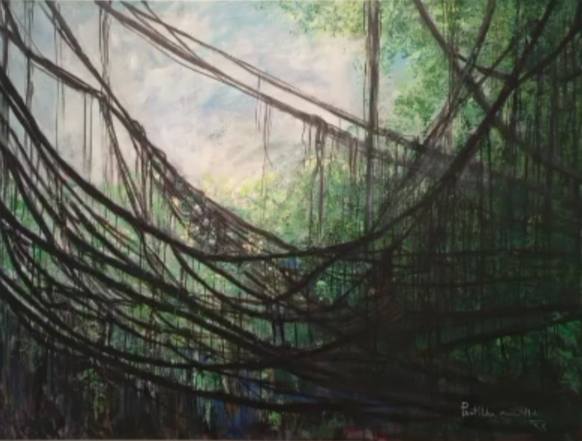
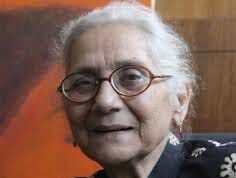
𝐆𝐨𝐠𝐢 𝐒𝐚𝐫𝐨𝐣 𝐏𝐚𝐥: 𝐀𝐫𝐭 𝐚𝐬 𝐀 𝐒𝐚𝐧𝐜𝐭𝐮𝐚𝐫𝐲 𝐨𝐟 𝐏𝐚𝐢𝐧-Art & Womenhood
“𝐀 𝐛𝐢𝐫𝐝 𝐝𝐨𝐞𝐬𝐧’𝐭 𝐬𝐢𝐧𝐠 𝐛𝐞𝐜𝐚𝐮𝐬𝐞 𝐢𝐭 𝐡𝐚𝐬 𝐚𝐧 𝐚𝐧𝐬𝐰𝐞𝐫, 𝐢𝐭 𝐬𝐢𝐧𝐠𝐬 𝐛𝐞𝐜𝐚𝐮𝐬𝐞 𝐢𝐭 𝐡𝐚𝐬 𝐚 𝐬𝐨𝐧𝐠.” echoing Gogi Saroj Pal’s philosophy. [ Ref.-1, Gogi Saroj Pal , Kinnari & Kinnari Mantras , 2008.] The interplay of pain and life could symbolize the duality of existence. The conceptualization of Gogi’s art is not confined to traditional norms. In her own words, “Freedom is a mental condition,”.[ Ref.-2, Gogi Saroj Pal , Kinnari & Kinnari Mantras , 2008.] She transcends the physical constraints of mortality in her artwork. The canvases become a space where pain is transcended, and the fleeting nature of life is depicted with both poignancy and resilience. One intriguing series envisioned by Gogi could involve the portrayal of the deceased navigating through an ethereal landscape, guided by symbolic elements.
Gogi Saroj Pal’s artistic journey unfolds as a poignant exploration of womanhood, a theme that she fearlessly embraces and proudly unravels in her work. Her paintings serve as a unique visual language, delving deep into the intricate layers of what it means to be a woman in contemporary India.
Reflecting on her artistic approach, Gogi articulates, “I have never felt apologetic for making woman the main focus of my work. I am rather proud of being a woman and trying to unravel through my work what makes a woman, how much of a woman is conditioned and how much natural.” .”[ Ref.-3, Gogi Saroj Pal , Beaing a women, 2010.]This unapologetic celebration of womanhood permeates her canvases, challenging societal norms and contributing to a broader discourse on the role of women in art.
Gogi’s evolution as an artist, as revealed in her interview, encapsulates a dynamic exploration of themes, mediums, and storytelling techniques. The iconography of women in her art serves as a profound reflection of societal expectations, encapsulating both delicate sensitivity in her earlier works and vibrant spontaneity in her current portrayals.
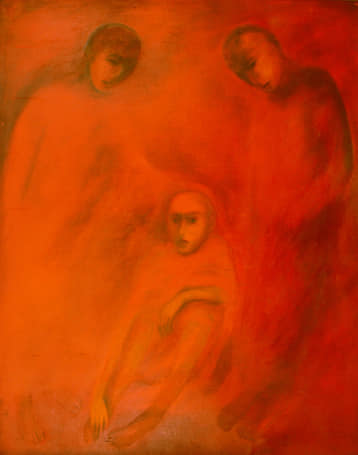
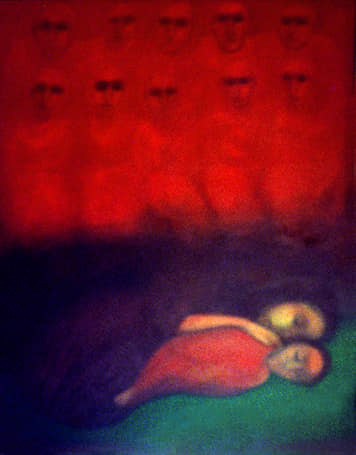
As Gogi shares insights from her interview, her commitment to portraying women becomes evident. She recalls, “The road to art is a long one, and I will not say that I knew there was an artist in me then. But what I do know is that there was in me a strong sense of curiosity.” .”[ Ref.-4, Gogi Saroj Pal , Kinnari & Kinnari Mantras , 2008.] This curiosity, coupled with a deep engagement with cultural roots, finds expression in themes such as “Aag ka Dariya” and the incorporation of indigenous motifs.
Gogi Saroj Pal’s artistic prowess extends beyond traditional themes offers a profound exploration of life’s transience. Drawing inspiration from her distinctive perspective, Gogi’s art becomes a visual struggle challenging perceptions and inviting viewers to confront the inevitable.
In contemplating her unique artistic choice, Gogi shares, “Pain and loss are a part of human existence. What matters is how well you bear them.” .”[ Ref.-5, Gogi Saroj Pal , Kinnari & Kinnari Mantras , 2008.] This sentiment becomes the cornerstone of her art, where she navigates the realms of grief and acceptance, using her canvas as a medium to express the universal human experience. Julia Kristeva’s concept of abjection is highly applicable to comprehend the works of Gogi Saroj Pal. Kristeva delves into the notion of abjection, which she defines as a visceral reaction to things that disrupt the boundaries between the self and the other. Abjection occurs when these boundaries are threatened or violated, leading to a visceral response of horror and repulsion. [Ref.-6, p-56,Julia Kristeva, Translated by Leon S. Roudiez – Powers of Horror_ An Essay on Abjection Columbia University, 1982.] Abjection is not only a personal psychological phenomenon but also a crucial aspect of cultural and social processes. In the paintings of Gogi Saroj Pal, Julia Kristeva’s concept of abjection finds a profound resonance, echoing through the intricate layers of pain, renewal, and the exploration of womanhood.
Another conceptualization could revolve around the metaphor of rebirth, with Gogi’s art depicting a transformative journey beyond physical limitations. Quoting her interview, “For a while, the sparrow or the Kinnari limped, but then she was flying,” [ Ref.-7, Gogi Saroj Pal , Kinnari & Kinnari Mantras , 2008.] this series could encapsulate the essence of renewal and the enduring spirit of life.
Gogi’s art delves into the dichotomy of existence, and she channels her personal struggles into a visual language. Reflecting on her own adversities, she remarks, “During the recent struggle with having the hip joint replaced and the muscles not able to cope and thus leaving me incapacitated for a long time and in excruciating pain, my art did come to my rescue.” [ Ref.-8, Gogi Saroj Pal , Kinnari & Kinnari Mantras , 2008.] This personal refuge in art during moments of physical anguish becomes a central theme in her explorations and become a sanctuary—where pain finds solace and the renewal unveils itself.
Gogi’s willingness to explore diverse mediums, from oil and gouache to ceramics and installations, is rooted in her adventurous spirit. Drawing from her interview, she affirms, “I was never afraid to re-invent or begin all over again.” [ Ref.-9, Gogi Saroj Pal , Kinnari & Kinnari Mantras , 2008.] This fearlessness in embracing change make her continuous quest for innovation natural and not imposed.
In essence, Gogi Saroj Pal’s foray into art becomes a testament to the artist’s ability to transcend conventional boundaries, using her craft to explore the intricate dance between life and no life. Her unique perspective, coupled with the visceral impact of her personal experiences, elevates art to a realm where contemplation and acceptance converge in a visual symphony of life. Her art emerges as a visual odyssey through womanhood, a narrative enriched by her personal reflections and societal observations. Her paintings transcend stylistic confines, inviting viewers to embark on a contemplative journey, exploring the myriad facets of the feminine spirit as captured by her brushstrokes.
(The End)