𝐀 𝐟𝐫𝐚𝐦𝐞 𝐰𝐢𝐭𝐡 𝐓𝐢𝐦𝐞 𝐌𝐚𝐜𝐡𝐢𝐧𝐞: 𝐖𝐚𝐧𝐝𝐞𝐫𝐢𝐧𝐠 𝐏𝐚𝐭𝐧𝐚 𝐒𝐚𝐡𝐢𝐛
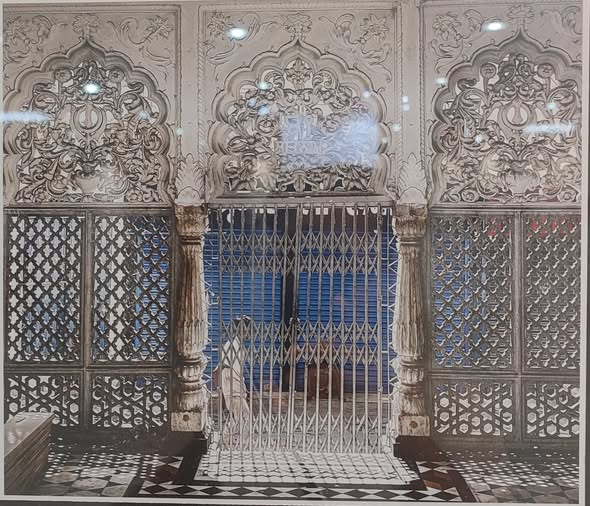
“To take a photograph is to align the head, the eye, and the heart. It’s a way of life.” This line was written in The Mind’s Eye (1999) by Henri Cartier-Bresson, a pioneer in street photography. I found this philosophy reflected in “Wandering Patna Sahib,” a photograph from “A Shutter Story,” a solo exhibition by Shaurya Chandra.
Shaurya Chandra‘s photograph has a personal, subjective sense of street photography at this very young age. To show this, I analyzed one of his photograph, “Wandering Patna Sahib,” which I like the most. “Wandering Patna Sahib,” seamlessly integrates the subjective sense of street photography with the timeless elegance of traditional architecture. The ornate entrance with its intricate carvings and lattice work, likely influenced by Mughal or Rajasthani styles, is captured with a sense of immediacy and presence. The detailed craftsmanship of the carved stone or metal showcases a rich heritage within the everyday context of street life.
Seeing comes before words. A child looks and recognizes before it can speak. Similar to this visual power, the image speaks directly to the viewer’s sense of sight, drawing them into its detailed complexity without the need for verbal explanation. The symmetrical composition of the photograph, with its central gate flanked by elaborate panels, creates a harmonious visual effect.
The play of light and shadow in the photograph, creating intricate patterns on the floor, adds depth and texture. Ansel Adams states in The Negative (1981), “A good photograph is knowing where to stand.” Chandra’s choice of perspective and the resulting shadows enhance the three-dimensional quality of the carvings, bringing the historical scene to life.
The contrast between the neutral tones of the carvings and the vibrant blue shutters in the background adds a modern touch to the historical setting. This juxtaposition similar to Susan Sontag’s reflections in On Photography (1977), where she writes, “Photographs furnish evidence. Something we hear about, but doubt, seems proven when we’re shown a photograph of it.” This photograph provides visual evidence of the coexistence of old and new, capturing the layered narrative of urban life.Such intricate entrances are often found in temples or historical buildings, indicating the location’s cultural and historical significance. The inclusion of a modern shutter gate introduces contemporary elements, underscoring the dynamic nature of street photography, which seeks to capture the evolving urban landscape.
In essence, Shaurya Chandra’s photograph is an intresting example of personal subjective sense of street photography . It beautifully balances aesthetic appeal and cultural significance, engaging the viewer both emotionally and visually.
( I wish this young photographer,Shaurya Chandra, to carry on this good work with patience and long-term planned practice and to continue exploring his visual skills. )