𝐖𝐡𝐢𝐬𝐩𝐞𝐫𝐬 𝐨𝐟 𝐆𝐫𝐞𝐞𝐧 𝐏𝐫𝐚𝐭𝐢𝐛𝐡𝐚 𝐀𝐰𝐚𝐬𝐭𝐡𝐢’𝐬 𝐒𝐨𝐥𝐨
In the quiet halls of Lalit Kala Akademi, amid the rhythmic hum of Delhi’s polluted autumn air, Pratibha Awasthi’s canvases stand like breathing forests. Her solo exhibition, Beyond the word, running from 12th to 18th October 2025, is an intimate passage.
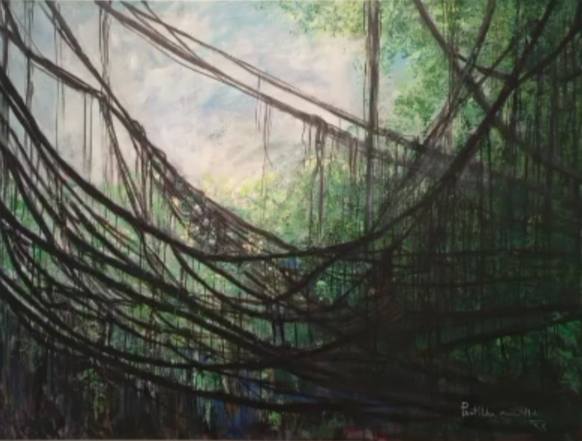
The painting before us does not describe nature, it becomes nature. One stands before it and feels an ancient pulse and the slow respiration of earth, moss, and water merging into one living consciousness.
𝐓𝐡𝐞 𝐏𝐨𝐞𝐭𝐢𝐜𝐬 𝐨𝐟 𝐓𝐞𝐱𝐭𝐮𝐫𝐞 𝐚𝐧𝐝 𝐁𝐫𝐮𝐬𝐡𝐰𝐨𝐫𝐤
At first glance, one is drawn to the deep green atmosphere. Thick, interwoven branches cross the canvas diagonally, forming a natural bridge – Meghalaya’s Root Bridge. Awasthi’s brushwork is fluid. The texture is layered, at times rough and tactile like bark. There are no human figures, yet the painting feels deeply inhabited by memory, by breath, by the unseen presence of life.
One senses that she builds her canvases the way nature builds terrain through slow accumulation, through erosion, through metamorphosis. Her brush rarely shouts, it breathes.
In the central regions of the painting, where dark roots converge, the texture thickens, almost sculptural. Elsewhere, she allows the paint to thin out, letting the canvas breathe through. This tension between density and transparency creates the sensation of depth not pictorial depth alone but emotional depth.
Her technique evokes a tactile empathy, one wants to touch the surface, to feel the dampness of moss or the brittleness of a dried branch. The painting’s physicality becomes part of its meaning.
The mist softens the composition, lending it a dreamlike melancholy. What might have been a landscape transforms into a psychological space, an interior forest of thought and silence. The viewer senses both decay and regeneration, as if the painting holds the rhythm of nature’s eternal cycle.
The viewer is not merely invited to see but to dissolve, to become one with the dense and sentient world that Awasthi conjures with pigment and intuition.
Awasthi’s mastery lies in how she transforms colour into consciousness. Standing before it, one feels both awe and surrender.
𝐓𝐡𝐞 𝐆𝐫𝐞𝐞𝐧 𝐚𝐬 𝐚 𝐋𝐢𝐯𝐢𝐧𝐠 𝐋𝐚𝐧𝐠𝐮𝐚𝐠𝐞
Awasthi’s dominant chromatic vocabulary is unmistakably green, yet this green is not decorative. One cannot ignore the way she manipulates tonal shifts, the greens darken into near-blacks, only to open up again in faint turquoise mist, like the breath of life returning after a long stillness.
Green, in Awasthi’s hands, becomes the colour of continuity between life and decay, between form and dissolution. It reminds us that beauty is not in the freshness of a leaf but in the process of its withering.
𝐁𝐞𝐭𝐰𝐞𝐞𝐧 𝐀𝐛𝐬𝐭𝐫𝐚𝐜𝐭𝐢𝐨𝐧 𝐚𝐧𝐝 𝐑𝐞𝐚𝐥𝐢𝐭𝐲
Pratibha Awasthi’s work operates on the border where figuration dissolves into abstraction. Her paintings neither describe nor deny the visible world. They hover at its edges, as if to remind us that perception is always incomplete. The forest here is not out there, it is within us, refracted through emotion, memory, and dream.
In that sense, Awasthi continues a line of Indian painters from Ram Kumar’s existential landscapes to Gaitonde’s meditative abstractions yet her idiom remains deeply personal. There is moisture in her atmosphere, the scent of decay, the whisper of wind.
Every stroke is a negotiation between presence and erasure. The roots that emerge in the foreground seem to dissolve into the green mist , they are both there and not there. The world she paints is transient, caught between being and unbeing. And in that in-betweenness lies her strength
𝐓𝐡𝐞 𝐀𝐫𝐜𝐡𝐢𝐭𝐞𝐜𝐭𝐮𝐫𝐞 𝐨𝐟 𝐖𝐢𝐥𝐝𝐞𝐫𝐧𝐞𝐬𝐬
At first glance, the composition seems abstract like a tangle of branches and shadows, but the longer one gazes, the more one perceives a deep architectural order beneath the seeming chaos. The diagonal bridges of dark wood, the layers of mist and the invisible light filtering through these are not accidents. They are the geometry of emotion.
This particular painting has the density of a dream. It recalls the spaces of memory rather than geography . The composition does not allow the eye to rest, it compels wandering. You enter it as one enters a forest cautiously and soon lose your sense of direction. That is precisely the artist’s triumph, she makes us lose ourselves to find something purer within.
𝐓𝐡𝐞 𝐅𝐞𝐦𝐢𝐧𝐢𝐧𝐞 𝐚𝐬 𝐄𝐥𝐞𝐦𝐞𝐧𝐭𝐚𝐥 𝐅𝐨𝐫𝐜𝐞
There is a quiet yet undeniable femininity in Awasthi’s landscapes, not in the superficial sense of prettiness, but in the deep sense of nurturing and enduring. Her forests feel maternal, they hold, protect, and absorb. The branches that interlace like arms and the veils of mist that soften every edge, these are gestures of care.
Yet, this maternal presence is not merely benevolent. It also contains an undercurrent of danger, the wild, untamable aspect of nature that refuses domination. The forest here is both womb and abyss, creation and dissolution.
Through this duality, Awasthi explores the archetypal relationship between woman and nature both revered and feared, both generative and destructive. Her art speaks the ancient language of earth’s cycles, a reminder that all life is rooted in surrender.
𝐒𝐢𝐥𝐞𝐧𝐜𝐞 𝐚𝐬 𝐒𝐨𝐮𝐧𝐝
What strikes one most in Awasthi’s work is its sonic quietness. The silence here is not absence but resonance . The silence of things that have their own ancient speech. One can almost hear the dripping of water, the hum of unseen life, the whisper of wind threading through branches. The painting vibrates with an inaudible music.
Standing before her work, one realizes that silence is perhaps the most eloquent medium available to painting. In her greens, we hear the murmurs of time.
𝐁𝐞𝐲𝐨𝐧𝐝 𝐭𝐡𝐞 𝐖𝐨𝐫𝐝 𝐚𝐧𝐝 𝐂𝐚𝐧𝐯𝐚𝐬
There is something ancient about the atmosphere of Awasthi’s work , a feeling that these forests have seen centuries pass. Time, in her paintings, is fluid. The decaying root and the emerging sprout coexist. Past and present are simultaneous.
Awasthi’s artistic philosophy seems rooted in a profound awareness of process. Her paintings are not planned compositions but organic evolutions. The green emerges not by decision but by listening to what the canvas wants to become.
Perhaps this is what makes her work so alive. Every canvas feels like a pause in an ongoing process, like the earth itself taking a breath.
Within the context of her solo exhibition at Lalit Kala Akademi, the cumulative effect of her works is overwhelming. Moving from one painting to another is like traversing different zones of a single consciousness , each canvas a microcosm of mood and rhythm. The urban noise outside Mandi House feels distant, irrelevant. For a moment, the city itself seems to breathe slower.
𝐓𝐡𝐞 𝐀𝐫𝐭𝐢𝐬𝐭’𝐬 𝐈𝐧𝐧𝐞𝐫 𝐕𝐢𝐬𝐢𝐨𝐧
What defines Pratibha Awasthi most as an artist is her inner vision. She does not chase realism because she understands that truth is not in appearances but in the vibration beneath them.
Her art is an act of communion between human and non-human, visible and invisible, self and cosmos. In an age of visual excess and conceptual posturing, her work returns us to the elemental: to colour, texture, breath, silence. She paints as one might pray not to be heard, but to belong.
She challenges the human ego’s dominion. Her forests, ungoverned and unyielding, assert their own presence. They do not ask to be understood, they simply are. And perhaps that is their deepest wisdom.
𝐓𝐡𝐞 𝐁𝐫𝐞𝐚𝐭𝐡 𝐨𝐟 𝐆𝐫𝐞𝐞𝐧
To stand before Pratibha Awasthi’s painting is to stand before an intelligence larger than oneself, not intellectual, but elemental. The green that dominates her world is not simply a colour, it is like a philosophy which speaks of life’s continuity. One realizes that the true subject of her work is not the forest, not even nature, it is being itself, process of being itself.
At the end of the exhibition, one carries a trace of that green and that process within a subtle shift in perception. The world outside seems less inert, more alive. That is the silent effect of Pratibha Awasthi’s art, it does not end on the wall, it continues in the viewer’s breath
( The End)